Studio Valle de Valle is reimagining the interiors of 41 Arvida. We were invited to design the light that lives inside them — for a client who has spent a career being seen, and a home built so he can choose, for once, when he isn't. This is how we'd read this house, and how we'd light it.
You chose plaster, iroko, microcement, felt — surfaces that were chosen to be felt, not to shine. Our scope is the renovated areas, and our role is singular: to reveal what you specified, never to compete with it.
This is the part most lighting plans get wrong. They light the room. We light the material, and let the room follow. The plaster wants grazing light; the felt wants to be lit from anywhere but the front; the microcement gives almost nothing back, so every fixture has to earn its place. None of that is visible in a render. All of it is the difference between a space and a space you don't want to leave.
What follows is how we read this house, the work that stands behind us, and the way we'd light it — in dialogue with you, at every stage.
Scope · Renovated interiors · with Studio Valle de Valle
The person who will live here thinks in frames before he thinks in rooms. Before the stage, before the records, the first language was film — and film taught him that light is never neutral. It withholds as much as it reveals. A face half in shadow. A room you read by what's left dark.
So we don't light this house to be seen. We light it the way a cinematographer lights a scene — for control, for restraint, for the feeling before the eye even names it. The artist has spent a career inside the most engineered light in the world. The person comes home to the opposite.

A film lover's eye is trained on a specific kind of light. The controlled dark of Kubrick, where precision is the whole point and nothing is lit by accident. The low, uneasy glow of Lynch, where a room means more for what it hides than what it shows. That isn't decoration — it's a way of seeing, and it's exactly how we work.
Single, intentional sources over flooded rooms. Gallery-grade light that lets material lead. Deliberate pools of shadow that make warmth feel warmer. You won't have to translate your references for us.

This house was designed to be touched. Plaster, iroko, microcement, felt — surfaces chosen for warmth and texture, not for shine. They don't reflect light; they hold it. Our work isn't to add brightness, but to let each material reveal what it already is.

In most homes the cinema is a feature. Here it's the center of gravity — the room a film lover actually lives toward. So we treat the whole house with a director's logic: light built in scenes, not switches. Pools of warmth and deliberate dark. The dome above the stair that stays dark on purpose, so the glow below feels warmer. A home where atmosphere is composed, the way a scene is — and where, when the lights go down, nothing pulls your eye away from the screen.

Curved, hand-finished, no shine to hide behind. Grazing light only — a low raking wash, close to the wall, along the curve. Skim it and it reads as texture, not surface.

Warm, directional, full of grain. Tight accents raked across the figure, color temperature held golden. Never flooded — the grain reads as depth, not gloss.

Soft, matte, seamless — almost no reflectance. One well-placed source, grazing or concealed, over many. Restraint keeps the surface continuous.

Absorbs sound and light alike. Indirect, warm, layered low — never aimed at the panels. The surface stays matte, the room closes in around you.
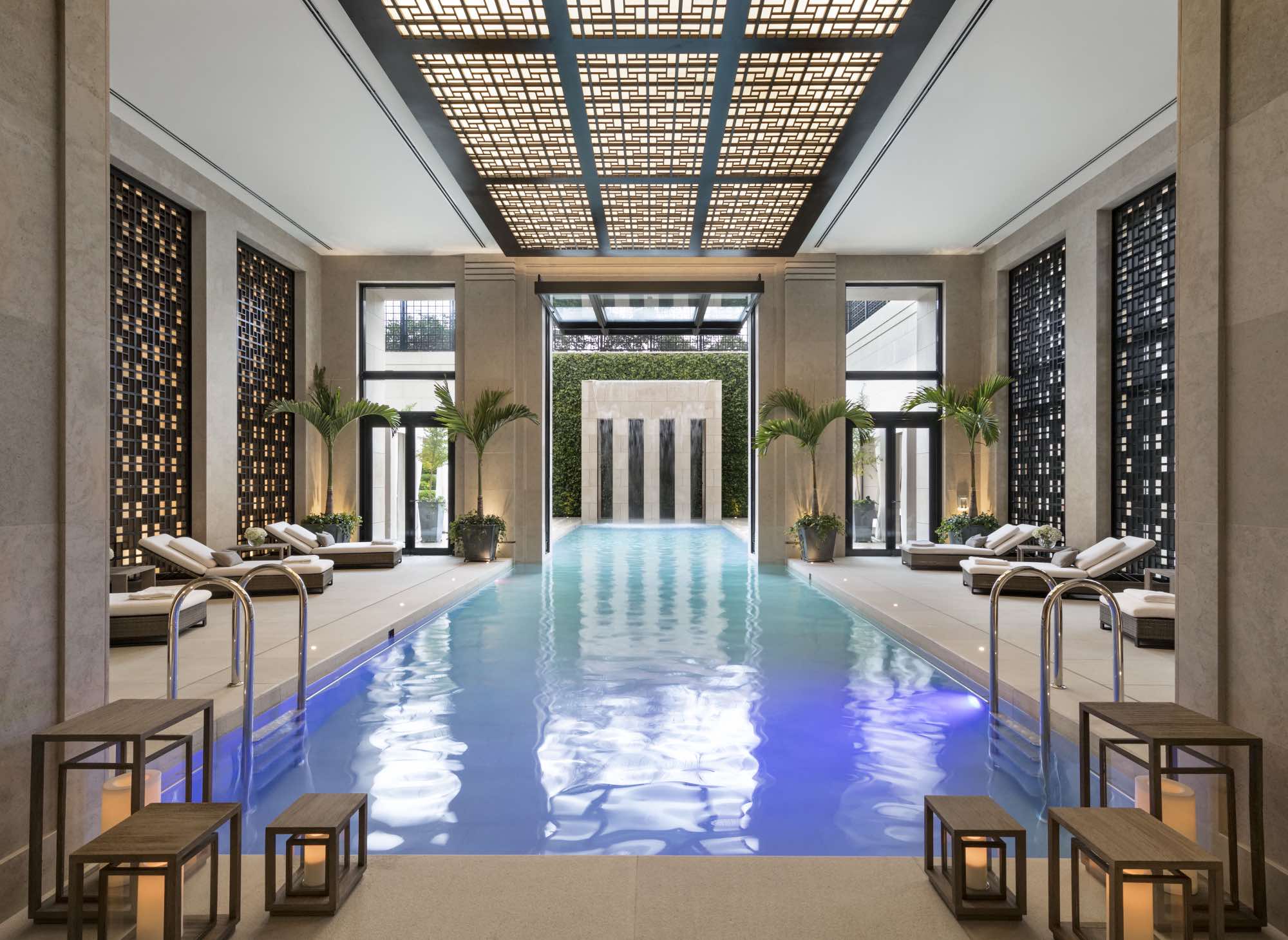
The first thing the house says about itself. We'd light it as a slow reveal — soft grazing along the curved plaster, so the wall glows from within. The palms catch a quiet, low accent. And the dark dome above stays dark, deliberately: a pool of shadow that makes the warmth below feel even warmer.
Nothing should feel switched on. It should feel like the house was always this way, and you simply walked in at the right hour.
Arrival as atmosphere — the first note of the house.


01
02
03
04
05
06
07
08
09
10
11What began as one person knocking on doors in Lima is now a practice of more than 80 people across three continents, with offices in Lima, Miami and Madrid. For a Coral Gables home, our Miami studio is already next door — not flying in, but here.
We've delivered more than 2,500 projects across six countries, working alongside firms like RAMSA, Oppenheim and Adriana Hoyos. But the number that matters most isn't on this list: it's that after three decades and that much scale, the studio still designs each project as if it were the only one. The throughline never changed — light, here, is never decoration. It's the soul of the architecture.
“I don't design light to be noticed. I design it so the room, the material, the person living there all feel inevitable. The best light in a home is the one no one ever thinks about. They just never want to leave.”
Karen has spent more than three decades building one of the few lighting practices that works at the level of the world's most demanding architecture firms — and keeps the soul of a studio. She leads the design on every project the studio takes, and she'd lead this one. When you work with Karen Mannheim Lighting Studio, you're not handed to a team. You start with her.
Concept, fixture design, control system, photometric calculations and a full construction dossier.
Open stage →Coordination, change management and scene calibration through construction.
Open stage →Site visits, supervision and light testing until everything is exactly right.
Open stage →A slow reveal. Grazing light on curved plaster; the dome left dark.
Low and intimate — the first shift in mood as you arrive.
Warm pools for reading; shelves lit to invite, not to display.
Layered scenes — from full gather to single-lamp quiet.
Morning light extended; tuned to the body's early clock.
One considered source over the table; everything else recedes.
Focused and glare-free, calibrated for long hours and the screen.
Flattering, soft, never clinical — light you look good in.
The last light of the day — dimmable to almost nothing, warm at the floor.
Vertical, even light at the mirror; a separate calm layer for night.
Indirect and warm, never into the felt — light you sit inside.
Graded for cinema. Zero glare, scene-controlled — the room the whole house is built toward.
Tropic Estate Land Trust
c/o David Weise & Associates
15821 Ventura Blvd., Ste 370
Encino, CA 91436
We'd be honored to design this alongside Studio Valle de Valle. We don't pitch — we partner. You've spent months understanding who this house is for. We've spent every day since you reached out doing the same — studying the materials, the rooms, the person who'll live here, as closely as we could. And if we do our work right, no one who lives here will ever think about the lighting at all. They'll just never want to leave the room.
Start the conversation +